


War Veterans Turning to Church
By Kimberly Winston
Religious News Service
(RNS) A new study has found that American veterans who had a negative experience serving during World War II attend church more frequently today than those who were less troubled by their service.
The study also found that when service members were fearful in combat, they reported prayer was a better motivator for getting them through it than several other factors, including the broader goals of the war.

VJ Day – World War II. Religion News Service file photo
Researchers say the study, which will be published in a future edition of the Journal of Religion and Health, has implications for health professionals, counselors and clergy who work with veterans with more recent service in Iraq and Afghanistan.
“The most important thing is that the more veterans disliked the war, the more religious they were 50 years later,” said Craig Wansink, a professor of religious studies at Virginia Wesleyan College and co-author of the study with his brother, Brian Wansink, a professor of consumer behavior at Cornell University.
“And the takeaway is that for people who work with combat veterans, if veterans have had a bad experience, it is clear that one alternative that has helped people understand the world or find a common community has been religion.”

Using the front of a jeep for an altar, Roman Catholic chaplain Joseph Kenny celebrates Mass for men of the 3rd Battalion, 82nd Airborne Division, before they depart France for the field in Belgium, January 6, 1945. Photo courtesy U.S. Arm Chaplain Museum, Fort Jackson, South Carolina
The study, titled “Are There Atheists in Foxholes? Combat Intensity and Religious Behavior,” also found that:
- As combat became more frightening, the percentage of soldiers who reported praying rose from 42 percent to 72 percent.
- After the war, soldiers who faced heavy combat attended church 21 percent more often if they felt their war experience was negative; soldiers who described their war experience as positive attended 26 percent less often.
- In general, religious behavior was high among all World War II veterans surveyed — approximately 69 percent were church members and reported attending services slightly more than three times per month.
The study was conducted with both old and new data, including data collected from U.S. Army service members in the Pacific in 1944 and from surveys the authors sent to surviving veterans more than 50 years later.
Brian Wansink said that while it is not surprising that service members in the heat of battle prayed — World War II journalist Ernie Pyle made the famous quip about atheists in foxholes that’s in the study’s name — it is important that those who work with veterans not overlook the impact of faith during and after combat.
“Religious involvement could help these people,” he said. “One reason it may have been so effective in the past is that religion is a very social experience, and that might be healing of itself because these are people who developed strong social bonds with their units and strong commitments to their comrades. That might be missing from current strategies in helping recent soldiers cope with stress.”

Jewish military chaplain Captain Robert S. Marcus conducts outdoor services at the Siegfried Line in Germany, amid “dragon’s teeth” ani-tank barriers, on November 3, 1944. Photo courtesy U.S. Army Chaplain Museum, Fort Jackson, South Carolina
The authors spent 12 years working on the study — three times as long as the U.S. involvement in World War II — and were influenced by respect for their father, a member of the so-called “Greatest Generation” who fought in the war.
“The takeaway for us is that the best thing you can do on Memorial Day is call that father or great uncle who is a veteran and wish him a happy Memorial Day,” Brian Wansink said.
KRE/AMB END WINSTON

Health & Prayer
By Josh Clark
How Stuff Works, Discovery
As science investigates connections between the mind and the body, some scientists have found that a person’s faith can help him or her live a longer, healthier life [source:Yang]. Prayer may lower blood pressure and heart rate, both of which can contribute to a more virileimmune system [source:Bernardi, et al.].
Other studies have found that people who are religiously active tend to be healthier. This may be due to the power of prayer, but it could also be explained by a tendency toward clean living, as many religions call upon their devotees to foreswear health risks like alcohol, cigarettes and casual sex. In addition, people active in their communities of faith may receive the help of social bonds within their religious groups. One study at the University of California – Berkeley factored in smoking and other lifestyle choices and still found that religious people have less risk for disease and death [source: Yang]. Inside the scientific community and out, many accept that praying can prove beneficial for a person’s health.
While praying for oneself may provide some health benefit, intercessory or distant prayer is another matter. Intercessory prayer (IP) is praying for a higher power to intercede on behalf of another person, usually for recovery from a health crisis. Distant prayer is a form of intercessory prayer in which someone prays for a person whom he or she has never met, often as a public request through a church or other institution of faith. The belief that this kind of prayer has any kind of effect on a person’s health invites scorn from much of the scientific community.
Scientific study on intercessory prayer has delivered mixed results, and those on each side of the debate embrace the results that support their beliefs. On one side are those who believe that things which can’t be proven via the scientific method doesn’t exist. On the other side are those who believe in the power of prayer — whether science can prove it or not.
But why is it such a contentious issue? According to a study at the University of Rochester, as many as 85 percent of people suffering from disease pray in addition to receiving medical treatment. Prayer is the number one complementary medicine for Americans, more than vitamins, herbs or therapeutic exercise like yoga. If it makes someone feel better — even if can’t be proven scientifically — what harm does prayer pose?
The notion that we humans possess a capability to heal others simply by using our minds — or by calling upon a higher power to intercede — flies in the face of science. But in the pursuit of the truth, researchers will investigate it scientifically. With so many people relying on prayer, scientists have a responsibility to determine whether it is helpful or harmful to people.
Photo Credit: www.inlandvalleychurch.com
Does Faith Make A Difference?
Chaplain Mark R. Johnston
Editor, ‘The Military Bible’ and ‘The Manual for Spiritual Fitness’
09/19/2013
Huffington Post

Suicide rates in the Army continue to challenge all who serve our great Nation. Last year’s record breaking numbers point to the disturbing dilemma that continues to this hour. This is disturbing because there is no institution in the world that does more in the effort to prevent suicide than the US Military. With multiple agencies, programs and events, suicide prevention remains a top priority within leadership in every branch of the Military. Excellent programs such as Applied Suicide Intervention Skills Training (ASIST) and Ask, Care Escort (ACE) Training touches every serving Soldier and is made available for families and DA Civilians. Chaplains, Chaplain Assistants and other health-care professionals are continuously engaged in an effort to educate, prevent and intervene with those who are struggling with suicidal ideation.
However, controversy follows the various efforts to understand and prevent the incalculable loss of human life through suicide. The debate over causes and effects leading to suicide, such as the belief that the contributing stress of combat and deployment as a contributing factor to the sharp rise in Military suicides, has been recently challenged by the Pentagon. Instead, mental illness seems to be a leading indicator of the cause-effect pattern in suicidal behaviors amongst Military personnel. Counterarguments against the Pentagon’s recently released study is sure to revive the intuitive belief that war remains a contributing factor in the depression and despair afflicting many who have been exposed to the horrors of combat and killing.
This belief is grounded in the common understanding that all human life is valued, including that of our enemies. This value often stems from traditional beliefs that include religious definitions of what constitutes an individual human being. One such religious tenet of faith points to persons being “created in the image of God,” suggesting that there is something implicitly sacred about life, and conversely, something profoundly profane about death, especially violent, premature death.
Many who have deployed into combat and have witnessed first-hand the violence and killing that characterizes war often return home with the uncomfortable realization that the value structure they once maintained, and perhaps called “normal,” does not necessarily fit any longer. Re-inhabiting a way of life predating the horrors of combat can be especially difficult once a person has been exposed to the act of killing other human beings. No matter how noble the cause for combat, and there are such noble causes, such horror and trauma permanently impacts those who have a conscious sensitivity about other human beings. How persons survive such readjustments and changes to their own personal world views presents one of the challenges to reclaiming any sense of “normal.” One means of such reclamation is through spirituality and the practice of spiritual disciplines.
Studies suggest that persons who have a religious faith or hope that transcends the personal dark moments characterizing intense psychological pain and despair (“psych-ache”) are better equipped to move beyond those windows of time that might otherwise frame suicidal ideation and subsequent suicidal attempts.
Targeting well-being, happiness, a sense of purpose and hope, these studies overwhelmingly support the existence of coping mechanisms that contribute to better mental health and resiliency for those who maintain and practice their faith.
A recent survey of such studies published by Harold G. Koenig is instructive to any who might question the value of spiritual fitness or resiliency as a component to wholeness and health. In his research, Religion, Spirituality, and Health: The Research and Clinical Implications (2012) he writes; “Those who are depressed, without hope, and with low self-esteem are at greater risk for committing suicide. At least 141 studies have now examined relationships between R/S (i.e. religion and spirituality) and the [sic] suicide variables.” He points out that in the most rigorous of these studies; “80% reported less suicide, fewer suicide attempts, or more negative attitudes toward suicide among the more R/S.”
Four religious variables emerge to suggest possible coping mechanisms for those who suffer depression and psych-ache. In their interviews of more than 37,000 persons in Europe and the U.S., Neelman and Lewis identified a) religious belief, b) attendance within a faith-based community, c) religious upbringing and d) religious or denominational affiliation as strengths for preventative and post-ventative approaches to stress, depression and suicidal ideation.
As an Army Chaplain this does not surprise me. Indeed, there are innumerable instances where Soldiers and family members have sought out religious counsel in times of incredible stress and darkness, finding relief from anxiety, purposelessness and despair to offset suicidal ideation. This has been the driving force behind “spiritual fitness” that comprises one of the five resiliency pillars in the Army’s Comprehensive Resiliency Program. This is the rationale behind the National Bible Association’s Military Bible and Spiritual Fitness Manual as well as the First Responder’s Bible and Spiritual Fitness Manual which attempt to reinforce spiritual resiliency through narrative and teaching. These are but two examples that promote a spiritual resiliency that survives human trauma. The Bible offers numerous stories and tips on becoming spiritually resilient and suicide resistant.
Within the Bible there are seven instances of suicide, six in the Old Testament and one in the New Testament. Within the context of Psalm 88, the despair that surfaces concludes with the author’s realization that his “only companion is darkness.” If that were the final message of the Psalmist, incredible psyche-ache and despair would be the final witness to his story. The following Psalm opens with a surprising note of praise to the Living God whose “Mercies are forever!” and suggests that there is a dawning light after every dark night of the soul. Hope is alive in the place of despair.
In like manner, the Christian hope can be demonstrated through the dynamic of the ‘crucified’ which suggests that there is a purpose that transcends suffering and death, found in the resurrection to new life that speaks against the seeming finality of death. Faith in this context provides a means of “passing through” the dark valley of the shadow of death where even the strongest persons are subject to pain, anxiety and despair. Suicide is trumped by the Crucified. Hope in the love and goodness of a forgiving God brings us closer to normal. Our lives are reclaimed in the process, regardless of how painful, when we believe in a purpose that extends beyond our own finitude. This is an act of faith, an act that typifies all who claim a spiritual core to their being and existence.
From the Huffington Post
Photo Credit: Examiner.com, AP Photo/Tony Gutierrez
Have You Prayed Today?
Here is your fun fact for the day!
We don’t plan to come find you and bonk you on the head, but make sure you spend time today in prayer. Lift up not only our men and women serving but the chaplains who are serving beside them, encouraging them and praying for them.
“Pray without ceasing.” 1 Thessalonians 5:17
Air Force Republishes Chaplain’s ‘No Atheists in Foxholes’ Article to Base Website
BY ALEX MURASHKO, CHRISTIAN POST REPORTER
The U.S. Air Force republished a chaplain’s devotional article to a base website after an official initially removed it in response to a complaint about its reflections on the famous quotation “There are no atheists in foxholes,” often attributed to President Dwight D. Eisenhower.
In early July, a devotional article by Lt. Col. Kenneth Reyes (USAF) wasposted on the website of the Joint Base Elmendorf-Richardson in the Chaplain’s Corner titled “No atheists in foxholes: Chaplains gave all in World War II.”
Shortly after the publication of the devotional, the Military Religious Freedom Foundation requested that the Air Force remove it off the base website and formally discipline Reyes, claiming it insulted those with no faith, according to WND.
The letter from the MRFF to the Air Force stated that in his article Reyes chose to “publicly denigrate those without religion.”
The activist group also stated that Reyes “defiles the dignity of service members by telling them that regardless of their personally held philosophical beliefs they must have faith.”
The Air Force removed the article within hours of receiving the complaint, according to WND.
“Chaplains have the freedom and obligation to speak about faith and religious values, and this freedom should not be censored or prohibited,” said Alliance Defending Freedom litigation counsel Kellie Fiedorek in a statement released Tuesday. “The Air Force should be commended for recognizing this and returning Chaplain Reyes’s essay to the ‘Chaplains Corner’ portion of his base’s website.”
ADF filed a Freedom of Information Act request earlier this month in an attempt to determine what led to the chaplain’s essay being censored in the first place. “We will continue to monitor that as we stand ready to defend our men and women in uniform just as they stand ready to defend us,” said Fiedorek.
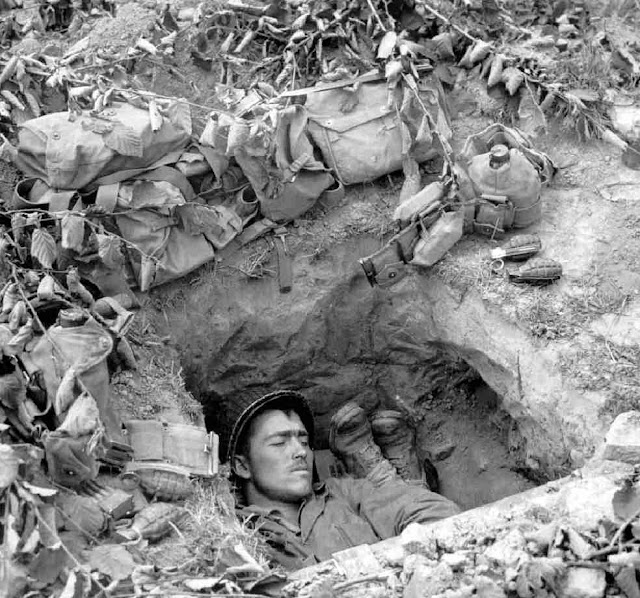
In his devotional article, Reyes writes that he interviewed a former World War II prisoner of war and friend who indicated that the phrase has been credited to Father William Cummings.
Father Cummings was a civilian missionary Catholic priest in the Philippines and the phrase was coined during the Japanese attack at Corregidor, Reyes writes.
He explains, “During the siege, Cummings had noticed non-Catholics were attending his services. Some he knew were not Catholic, some were not religious and some were even known atheists.
“Life-and-death experiences prompt a reality check. Even the strongest of beliefs can change, and, I may add, can go both ways – people can be drawn to or away from ‘faith.’ With the pending surrender of allied forces to the Japanese, Cummings uttered the famous phrase ‘There is no such thing as an atheist in a fox hole.'”
In an American Legion Program broadcast from the White House on Feb. 7, 1954, Eisenhower used the expression during in his remarks.
Reyes’ devotional article: ‘No atheists in foxholes’: Chaplains gave all in World War II.
Original Article: http://www.christianpost.com/news/air-force-republishes-chaplains-no-atheists-in-foxholes-article-to-base-website-102226/
Pentagon Classifies Evangelical Christians, Catholics as “Extremists”
By Todd Starnes
Fox News
The Department of Defense classified Catholics and Evangelical Christians as religious extremists similar to Al-Qaeda, according to training materials obtained by the Chaplain Alliance for Religious Liberty.
The Pentagon also considered the Southern Poverty law Center’s “hate group” list a “reliable source” for determining extremism and labeled “Islamophobia” as a form of religious extremism.
The revelations come just days after Judicial Watch discovered a separate Pentagon training document that depicted the Founding Fathers as extremists and conservative organizations as hate groups.
The Chaplain Alliance uncovered in more than 1,500 pages of documents obtained through a Freedom of Information Act request after a U.S. Army training instructor told a Reserve unit based in Pennsylvania that Catholicism, Evangelical Christianity, Al Qaeda, Hamas, Sunni Muslims, and the Ku Klux Klan were examples of extremism.
PENTAGON CALLS FOUNDING FATHERS EXTREMISTS
CHECK OUT THE ARMY’S LIST OF DOMESTIC HATE GROUPS
“The materials we obtained establish that the U.S. military violated its appropriate apolitical stance and engaged in a dishonorable mischaracterization of multiple faith groups,” said Ron Crews, executive director of the Chaplain Alliance, an organization that represents thousands of military chaplains.
The documents show an unknown number of equal opportunity officers were trained at Fort Jackson, SC, using information obtained from the SPLC.
The training material was made public after a soldier who attended the briefing alerted Chaplain Alliance.
“He considers himself an Evangelical Christian and did not appreciate being classified with terrorists,” Crews said. “There was a pervasive attitude in the presentation that anything associated with religion is an extremist.”
The soldier “produced the slides based on EO Leader’s Course Program of Instruction obtained from the Soldier Support Institute at Fort Jackson, South Carolina,” the document reads.
In addition to the slide presentation, the Reserve unit was also shown a video provided by the SPLC and Teaching Tolerance. The trainer told her superior officers she showed the video because it was part of the “EO Advisor course curriculum.”
Crews is calling on the Pentagon to stop relying on the Southern Poverty Law Center or any other group that considers mainline religious organizations to be extremist or terrorist groups.
“Men and women of faith who have served the military faithfully for centuries shouldn’t be likened to those who have regularly threatened the peace and security of the United States,” Crews said. “The materials we have received verify that the military views the Southern Poverty Law Center as a reliable source for Equal Opportunity briefings.”
The Pentagon did not return calls seeking comment. Last April, spokesman George Wright told Fox News the training briefing in Pennsylvania was an “isolated incident not condoned by the Department of the Army.”
“This slide was not produced by the Army and certainly does not reflect our policy or doctrine,” he said. “It was produced by an individual without anyone in the chain of command’s knowledge or permission.”
The Army said the slide was removed, the presenter apologized and they considered the matter closed.
“Mr. Wright’s response is accurate but incomplete,” Crews told Fox News. “Yes, the one offensive slide was deleted, but how many other EO officers continue to use the SPLC as a source for training materials?”
Article from FoxNews.com: http://radio.foxnews.com/toddstarnes/top-stories/pentagon-classifies-evangelical-christians-catholics-as-extremists.html